Effects of the El Niño-Southern Oscillation on Climate Change-Induced Coral Bleaching Events
By Caroline Bazydlo, Maya Chambers, Emma Esau, Veronica Peroni Santos, Ella Wright
Coral reefs are rapidly deteriorating as anthropogenic climate change raises ocean temperatures. Past large-scale bleaching events have been linked to the El Niño-Southern Oscillation (ENSO), the largest source of interannual climate variability. The Southwest Pacific, home to many vulnerable reefs including the Great Barrier Reef (GBR), has shown a large correlation between severe bleaching and ENSO events.
Warming has had severe impacts on marine life, with almost 80% of marine species being negatively affected (Venegas et al. 2023). Of these, corals are particularly affected as a 1-2°C sea surface temperature (SST) increase is enough to create stress and trigger coral bleaching (National Oceanic and Atmospheric Administration 2006). Corals depend on a mutually beneficial relationship with algae that live within the coral and provide it with essential nutrients. However, when corals become stressed, they reject the colourful algae, giving them a ‘bleached’ appearance.
El Niño-Southern Oscillation in Australia
The ENSO has indirect impacts on coral bleaching due to its effect on local climate systems. The ENSO consists of two components, El Niño and La Niña. These phases are driven by Pacific air-water interactions and have opposite effects (Yang et al. 2018). El Niño events occur when trade winds are weakened or reversed, and result in decreased precipitation in Australia (Figure 1). This increases the oceans’ sun exposure, raising SSTs (McGowan and Theobald 2017). This can cause marine heat waves over prolonged periods of time, leading to severe bleaching as seen in 2016 (McGowan and Theobald 2017; Eakin et al. 2019). In comparison, during La Niña, trade winds are strengthened, bringing more warm water towards Australia (Yang et al. 2018). This results in increased rain, cloud cover, and cyclone frequency, meaning La Niña indirectly contributes to bleaching by increasing physical damage to coral.

Figure 1. The ENSO cycles’ effects on Australia. El Niño results in increased sun exposure and subsequently raised SST. This causes the thermocline, which is the transition from warm surface water to cold deep water, to become shallower in the west and deeper in the east. La Niña leads to increased rainfall and a higher frequency of cyclones. The thermocline becomes deeper in the west and shallower in the east (Yang et al. 2018).
Changes in the El Niño-Southern Oscillation
As atmospheric conditions continue to warm around the equator it is expected that this will decrease east-west trade winds (Cai et al. 2020). This can result in the flattening of the thermocline gradient, making ENSO events more likely to occur. In fact, some models predict that strong El Niño and La Niña events will double in frequency with projected greenhouse gas warming (Cai et al. 2015; 2014). This poses a large risk to coral reef ecosystems, such as the GBR, as this can lead to more frequent and prolonged increases in SSTs, resulting in severe bleaching.
Impacts on Humans and Marine Life
Coral reefs support approximately 25% of marine species, and the GBR specifically is home to hundreds of coral, fish, and other species (Plaisance et al. 2011). Coral bleaching leaves the reef prone to internal erosion and breakage from increasingly severe storms (Hutchings et al. 2013). This habitat loss causes altered food webs as prey availability is reduced. Reef erosion also exposes seagrass and mangroves to erosion, which are key habitats for green turtles (Figure 2) (Cullen-Unsworth and Unsworth 2018).
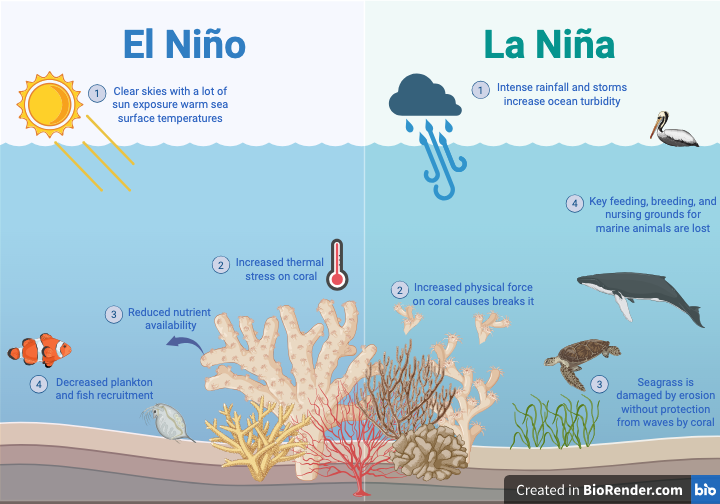
Figure 2. El Niño’s warmer water, clearer conditions, and weaker currents increase coral thermal stress, which reduces nutrient availability and, in turn, plankton productivity and fish recruitment. La Niña’s cooler water, intense rainfall, strong storms and stronger currents cause physical coral and seagrass damage. This physical damage to reefs reduces nursery habitats and shifts species distribution as well as physical ecosystem structure. Predators, including seabirds, are declining as less food is available (Keller et al. 2009; Woodworth et al. 2021).
The GBR is vital for Australians, generating $5.9 billion CAD annually while employing 64,000 people (Australian Government Great Barrier Reef Marine Park Authority 2025a). Additionally, Indigenous Australians, Torres Strait Island peoples, rely on the reef for food and spiritual purposes (Australian Government Great Barrier Reef Marine Park Authority 2025b). Beyond the GBR, it is estimated that 500 million people rely on the ocean as a primary food source (National Oceanic and Atmospheric Administration 2025). As ocean temperatures will continue to increase and ENSO events become more frequent these industries, cultures, and diverse ecological ecosystems will face irreversible impacts.
References
| Australian Government Great Barrier Reef Marine Park Authority. 2025a. “Fascinating Facts about the Great Barrier Reef | Reef Authority.” https://www2.gbrmpa.gov.au/learn/fascinating-facts-about-great-barrier-reef. |
| Australian Government Great Barrier Reef Marine Park Authority. 2025b. “Great Barrier Reef Traditional Owners | Reef Authority.” April 28. https://www2.gbrmpa.gov.au/learn/traditional-owners/great-barrier-reef-traditional-owners. |
Cai, Wenju, Simon Borlace, Matthieu Lengaigne, et al. 2014. “Increasing Frequency of Extreme El Niño Events Due to Greenhouse Warming.” Nature Climate Change 4 (2): 111–16. https://doi.org/10.1038/nclimate2100.
Cai, Wenju, Agus Santoso, Guojian Wang, et al. 2020. “ENSO Response to Greenhouse Forcing.” In El Niño Southern Oscillation in a Changing Climate. American Geophysical Union (AGU). https://doi.org/10.1002/9781119548164.ch13.
Cai, Wenju, Guojian Wang, Agus Santoso, et al. 2015. “Increased Frequency of Extreme La Niña Events under Greenhouse Warming.” Nature Climate Change 5 (2): 132–37. https://doi.org/10.1038/nclimate2492.
Cullen-Unsworth, Leanne C., and Richard Unsworth. 2018. “A Call for Seagrass Protection.” Science 361 (6401): 446–48. https://doi.org/10.1126/science.aat7318.
Eakin, C. Mark, Hugh P. A. Sweatman, and Russel E. Brainard. 2019. “The 2014–2017 Global-Scale Coral Bleaching Event: Insights and Impacts.” Coral Reefs 38 (4): 539–45. https://doi.org/10.1007/s00338-019-01844-2.
Hutchings, Pat, Mireille Peyrot-Clausade, and Anke Stuken. 2013. “Internal Macrobioerosion on Five Species of Acropora Following the 1998 Bleaching Event: Implications for the Long-Term Impact of Bleaching on the Great Barrier Reef.” Pacific Conservation Biology 19 (4): 409–17. https://doi.org/10.1071/PC130409.
Keller, Brian D., Daniel F. Gleason, Elizabeth McLeod, et al. 2009. “Climate Change, Coral Reef Ecosystems, and Management Options for Marine Protected Areas.” Environmental Management 44 (6): 1069–88. https://doi.org/10.1007/s00267-009-9346-0.
McGowan, Hamish, and Alison Theobald. 2017. “ENSO Weather and Coral Bleaching on the Great Barrier Reef, Australia.” Geophysical Research Letters 44 (20): 10,601-10,607. https://doi.org/10.1002/2017GL074877.
National Oceanic and Atmospheric Administration. 2006. Coral Bleaching - A Review of the Causes and Consequences. https://www.coris.noaa.gov/activities/reef_managers_guide/reef_managers_guide_ch4.pdf.
| National Oceanic and Atmospheric Administration. 2025. “Coral Reef Ecosystems | National Oceanic and Atmospheric Administration.” September 25. https://www.noaa.gov/education/resource-collections/marine-life/coral-reef-ecosystems. |
Plaisance, Laetitia, M. Julian Caley, Russell E. Brainard, and Nancy Knowlton. 2011. “The Diversity of Coral Reefs: What Are We Missing?” PLOS ONE 6 (10): e25026. https://doi.org/10.1371/journal.pone.0025026.
Venegas, Roberto M., Jorge Acevedo, and Eric A. Treml. 2023. “Three Decades of Ocean Warming Impacts on Marine Ecosystems: A Review and Perspective.” Deep Sea Research Part II: Topical Studies in Oceanography 212 (December): 105318. https://doi.org/10.1016/j.dsr2.2023.105318.
Woodworth, Bradley K., Richard A. Fuller, Graham Hemson, Andrew McDougall, Bradley C. Congdon, and Matthew Low. 2021. “Trends in Seabird Breeding Populations across the Great Barrier Reef.” Conservation Biology 35 (3): 846–58. https://doi.org/10.1111/cobi.13630.
Yang, Song, Zhenning Li, Jin-Yi Yu, Xiaoming Hu, Wenjie Dong, and Shan He. 2018. “El Niño–Southern Oscillation and Its Impact in the Changing Climate.” National Science Review 5 (6): 840–57. https://doi.org/10.1093/nsr/nwy046.