SAFs & Fuel-Efficient Engines
By Arham Saeed, Ahad Syed, Julie Mesha & Lucas Monter
Aviation’s Harmful Impact on Climate
The aviation industry has undergone many innovations over the past century to advance aircraft; however, its environmental impact wasn’t factored in. Today, approximately 2.5% of global carbon dioxide (CO2) emissions are produced by the aviation industry, and aviation accounts for 4% of global climate change (Ritchie 2024). Aircraft contribute to climate change through contrails (white streaks left behind by aircraft), cloud formation, CO2 emissions and NOx emissions (Lee et al. 2009). GHG emissions from aircraft can be mitigated by synthetic aviation fuel (SAFs) and fuel-efficient engines. Unlike fossil fuels, SAFs are a renewable fuel derived from human waste and biomass, such as oils and fats (Shahriar and Khanal 2022). Furthermore, Rolls-Royce and Pratt & Whitney are designing and manufacturing fuel-efficient engines that maintain power output with minimal fuel use and GHG emissions (Pratt & Whitney 2015) (Aerovision International 2021).
Key Results and Takeaways from FaIR Modelling
The Finite Amplitude Impulse Response (FaIR) model can be used to predict temperature increases due to CO2, NOx and the impact of GHG on Earth’s energy levels (Smith et al., 2018). We modelled the increase in temperature over 100 years attributable to CO2 from the novel Pratt & Whitney Geared Turbofan engines and computed a contribution of approximately 0.05°C. We modelled best and worst-case scenarios (conservative and aggressive forecasts of Pratt & Whitney’s engine efficiency) and found significant differences between their curvature over the same 100-year epoch (p = 9.99 x 10⁻⁴) (Figure 1). Considerations for the compound annual growth rate of aviation travel were implemented into a secondary model and should be further explored.
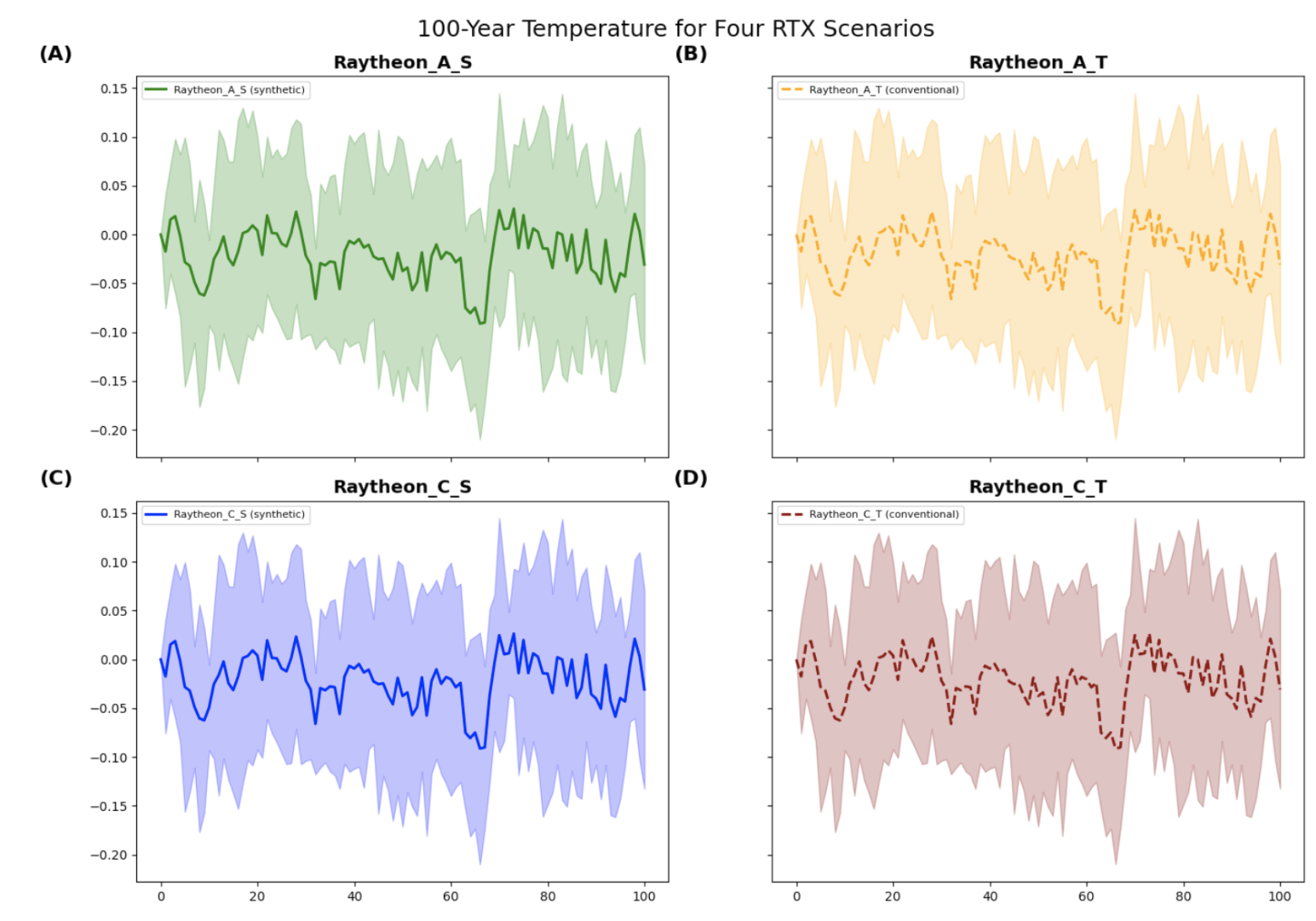
Figure 1: A comparison of the four scenarios using RTX Pratt & Whitney engines, modelled using FaIR in this review, wherein A = aggressive (30% engine efficiency), C = conservative (25% engine efficiency), S = synthetic fuel-efficient engine, T = traditional non-fuel-efficient engine. Each scenario is run for the next 100 years, starting at 2026, ending 2125.
Discussing the Implications of Aviation Emissions Modelling
This solution shows strong potential as it connects the realistic aviation data with an esteemed climate model. It uses the FaIR model, recognized by the IPCC, thereby enhancing its credibility while acknowledging its limits, providing confidence in the model’s findings. Technologically, including real efficiency values, growth rates, and manufacturer data makes results more practical and applicable, as the dynamic time warping reveals that even the smaller, modest efficiency gains can produce long-term benefits.
Financially, the usage of this model also identifies the importance of transparency and offering information to pertinent investors. An uncertainty for investors leads to less drive to engineer and invest in new technologies that will yield long-term gains. Socially, this model also corrects public misconceptions and clarifies the total climate impact of aviation, which is smaller than is generally assumed. Politically, this solution encourages data-driven policies that are dependent on reported global standards. Overall, this solution offers a balanced, evidence-based perspective that links data accuracy with real-world industrial and societal relevance.
Key Takeaways of the Proposed Solution
The combined use of SAFs and fuel-efficient engines poses a promising solution. SAFs provide immediate emission reductions as most meet current fuel specifications and can be blended with conventional jet fuels (Detsios et al. 2023). The use of SAFs also opens the door to life-cycle CO2 emission reductions when produced using renewable energy and low-carbon sources, while also reducing non-CO2 contributions, such as soot and contrail ice (Puschnigg et al. 2023 and Khan 2025). Furthermore, newer planes with fuel-efficient engines have been shown to emit around 20% less CO2 per flight due to lower fuel consumption (Bernardo and Fageda 2025). Both strategies, when combined, have a synergistic effect that greatly reduces the aviation industry’s overall emissions and the overall impact on climate change.
References
Aerovision International. 2021. “How Can Aircraft Engines Increase Their Efficiency?” September 29.
    https://aerovi.com/aircraft-engine-efficiency/.

Bernardo, Valeria, and Xavier Fageda. 2025. “The Impact of New Aircraft on Carbon Emissions.” Transportation Research Part D: Transport and Environment 147 (October): 104949.
    https://doi.org/10.1016/j.trd.2025.104949.

Detsios, Nikolaos, Stella Theodoraki, Leda Maragoudaki, Konstantinos Atsonios, Panagiotis Grammelis, and Nikolaos G. Orfanoudakis. 2023. “Recent Advances on Alternative Aviation Fuels/Pathways: A Critical
    Review.” Energies 16 (4): 1904. https://doi.org/10.3390/en16041904.

Khan, Sameer. 2025. “Exploring the Non-CO2 Climate Benefits of Sustainable Aviation Fuel and Low-Aromatic Jet Fuels.” VURDHAAN | Your Sustainability, Our Expertise, May 6.
    https://vurdhaan.com/exploring-the-non-co2-climate-benefits-of-sustainable-aviation-fuel-and-low-aromatic-jet-fuels/.

Lee, David S., David W. Fahey, Piers M. Forster, et al. 2009. “Aviation and Global Climate Change in the 21st Century.” Atmospheric Environment 43 (22): 3520–37.
    https://doi.org/10.1016/j.atmosenv.2009.04.024.

Puschnigg, Stefan, Karin Fazeni-Fraisl, Johannes Lindorfer, and Thomas Kienberger. 2023. “Biorefinery Development for the Conversion of Softwood Residues into Sustainable Aviation Fuel: Implications from Life

Cycle Assessment and Energetic-Exergetic Analyses.” Journal of Cleaner Production 386 (February): 135815.
    https://doi.org/10.1016/j.jclepro.2022.135815.

Ritchie, Hannah. 2024. “What Share of Global CO₂ Emissions Come from Aviation?” Our World in Data, April 8.
    https://ourworldindata.org/global-aviation-emissions.

Shahriar, Md Fahim, and Aaditya Khanal. 2022. “The Current Techno-Economic, Environmental, Policy Status and Perspectives of Sustainable Aviation Fuel (SAF).” Fuel 325 (October): 124905.
    https://doi.org/10.1016/j.fuel.2022.124905.

Smith, Christopher J., Piers M. Forster, Myles Allen, et al. 2018. “FAIR v1.3: A Simple Emissions-Based Impulse Response and Carbon Cycle Model.” Geoscientific Model Development 11 (6): 2273–97.
    https://doi.org/10.5194/gmd-11-2273-2018.